Part 6 - Full Nominal Roll & Casualty List
Chapter 1 - #1 Reception Camp - Eastbourne, UK
The Headquarters of No.1 AIF Reception Group were initially established at High Whycombe in Buckinghamshire, while the No.1 AIF Reception Camp established its Headquarters in the Sussex coastal town of Eastbourne in a stately mansion called "Chasely" renamed "Gowrie Gate" by Countess Gowrie in February 1945. An associated HQ Canteen was set up in the Sandhurst Hotel, on Marine Parade.
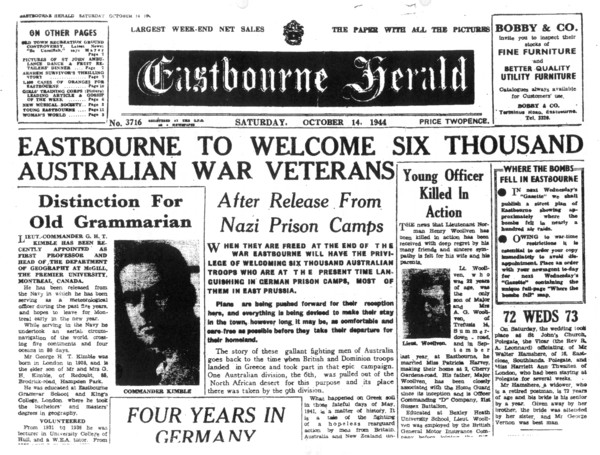
Other Reception Specialist Units - Medical, Dental, Postal and Provost Camps, initially based in Hazlemere Park, High Wycombe in 1944 were gradually moved down to Eastbourne early in 1945 as the first AIF POW "Free Men" from Europe began to trickle in. They were soon to be followed by the AIF POW liberated from German prison camps. According to Section Two - The Imperial List - of the German Prisoner of War Statistics, among the 5,000 plus AIF POW held in German hands, were 224 AIF Commissioned Officers. These included 8 Lt Colonels and 20 Majors.
The 8 Senior Officers were:
VX21 T/Lt Col I.R. Campbell 2/Ist Inf Bn
VX20314 Lt Col H.G.F. Havlock 2/1st Fld Rgt RAA
WX3326 Lt Col L.E. Le Soeuf 2/7th Fld Ambulance
QX6175 Lt Col F.R. Marlan 2/15th Inf Bn
SX8974 T/Lt Col L. McCarter 2/28th Inf Bn
NX496 Lt Col E.E. Munro 2/3rd Anti Tank Rgt
VX14840 Lt Col A. Spowers 2/24th Inf Bn
VX32 Lt Col T.G. Walker 2/7th Inf Bn
As the No.1 AIF Reception Camp braced itself to receive the expected flood of its returning POW, it recognised that it needed to utilise the experience and skills of these senior POW and split itself into four separate "Battalion" camps.
Both the Reception Group and Camps were under British Command but administrative officers were all Australian. The Australian Commanding Officer at Eastbourne was Lt Col Geoff Smith DSO of the 2/24th Inf Bn. A separate AIF Reception Transit Camp was created with an ancillary canteen at No.3 Bolsover Road.
On the 16th of January, 1945, Stan Peebles, who had arrived in the UK from Switzerland in November with a party of other AIF POW "partisans", had taken his 60 days leave and had celebrated an English White Christmas. He was among the 33 "processed" AIF POW to embark on The "Queen Elizabeth" for the journey back home to Australia.
The following embarkation list, in non-alphabetical order, includes nearly all the AIF POW escapers who fought with the partisans of North Italy. The Recorder's notes in italics alongside individual names corrects some minor errors and provides more relevant service detail.
WX30314 Capt Joshua Shilkin AEME - Dis. 22.08.47
B2/364 J. Orr
VX43343 WOII John Thornton Grimwade 2/8th LAA - Dis. 05.05.45
VX23350 Sgt Kenneth Rupert Fretwell LHQSOF(AA) - Dis 10.09.45
WX26125 Sgt R.C. Crawley
WX26135 Reginald James 2/3rdLAA - Dis 18.07.45
VX4401 J. Fenwick
VX41601 Julius Aylmer 2/24th - Sw. Dis. 27.08.45
VX18692 Cyril Henderson Ist Aust Corps - Sw. UK 03.11.44 Dis. 21.07.45
QX10792 L/Cpl G. Henderson William James Bushnell, 2/15th Roll.
Dis. 31.08.45
VX1141 R.E. Powell VX1114 Ray Edward, 2/7th Dis. 27.08.45
VX45906 Corke Neil Hartley, 2/3rd LAA Sw. Dis. 17.07.45
VX33876 Frank Curr, 2/24th Sw. UK 03.11.44. Dis. 23.07.45
WX10061 Daglish A. Harold, 2/28th Sw. UK 03.11.44. Dis. 18.07.45
WX4695 Hubbard Leslie Eric,2/28th, Sw. UK 03.11.44. Dis. 13.11.45
WX11748 Wilson Albert Rolfe,2/28th Sw. UK 03.11.44. Dis. 01.08.45
NX24504 Barry Clive Stephen, 2/13th.Sw.UK 03.11.44. Dis.18.07.45
WX7814 Black Daniel, 2/28th. It. Parts. Dis. 03.07.45
WX9612 Clarkson Charles Wintringham, 2/28th It. Parts. Dis. 11.07.45
WX9147 Fitzgerald John. 2/28th. It. Parts. France Dis. 16.07.45
WX7112 Malins George Frederick, 2/28th It. Parts. Dis. 13.09.45
WX104062 Morley Edward Arthur Wm., 2/48th. It. Parts. Dis. 11.07.45
WX9903 Nelson John Charles, 2/28th. It. Parts. France Dis. 25.07.45
WX13239 Vigar Raymond Leighton, 2/28th, It. Parts. France Dis. 11.07.45
WX9970 Wainewright Herbert Geo. Lewis, 2/28th It. Parts. France Dis 15.07.45
NX34504 R. Paton
NX34604 Ray, 2/3rd A/Tank, It. Parts Dis.01.09.45
QX10636 E.A.G. Hungerford
QX10626 Francis Sydney Geo. 2/15th Dis.20.08.45
VX31755 Peebles Stanley Eric L/Cpl, 2/24th. It. Parts. Sw. Dis. 21.07.45
VX38618 E.H. Sproule Ian Hamilton St. George, 2/32nd It. Pts. Dis 21.07.45
NX21419 Blair William, 2/17th. It. Parts. Dis. 01.09.45
NX17211 Garbutt Alan, 2/3rd A/Tank. It. Parts. Dis. 13.07.45
VX28355 Laurie Edward Albert, 2/6th Esc. Stalag 18A Dis. 12.08.45
TX2378 Rushton George Edward, 2/12th Esc Stalag 18A Dis. 23.07.45
NX1121 Gierson Edward Henry Rufus 2/1st (on compassionate grounds)
WX5507 Betts Albert John, 2/28th Dis. 20.07.45
QX7756 Bailey William Edward, 2/9th Dis. 01.09.45
VX33354 Phipps George Alfred, 2/3rdLAA. It. Parts. Dis. 13.07.45
VX33008 Anchen Humphrey Alexander, 2/3rd LAA 12.07.45
VX8431 Cahir James Patrick, 2/6th. Underground I. Dis. 14.09.45
On that same day, a Routine Order from Captain C.F.W. Baylis placed the Clifton Hotel in South Street out of bounds to all ranks. Stan Peebles said it had nothing to do with their farewell party the night before!
Among the early arrivals coming back from Germany was QX930 Bob Hooper, one of the 18 sappers from the 2/7th Field Coy taken POW with the 2/28th Inf Bn at El Alamein - "Escaper Extraordinaire" whose story is outlined in "Barbed Wire and Bamboo" M4. His final escape was from a German prison camp in Chemnitz and he met up with the advancing Americans who took him to Charleroi in Belgium.
On February 5, 1945, the next contingent of 62 "processed" AIF POW and minders embarked on transport J5 ("Arundel Castle"). They were:
VX16469 Acocks Sgt George Frederick, I Aust. Rec. Camp 21.08.45
VX12021 Pte. Arthur Newson Anderson, 2/6th Inf Bn, 01.11.45 18A
VX10115 Cpl. William Steven Andrews, 2/7th Inf Bn, 05.10.45 8A
NX3195 Gnr. Holman Lindsay Asquith, 2/1 Fld Rgt, 29.09.45 383
QX5534 Cpl. John Patrick Black, 2/32nd Inf Bn, 20.10.45 18A
VX37331 Pte. Gregson Bolton Benchley, 2/24th Inf Bn (?), 19.10.45?
VX15005 Pte. Joseph Brown, I Aust Corps, 28.09.45 18A
VX11523 Pte. Reginald Charles Brown, 2/6th Inf Bn, 27.08.45 8A
VX12636 Sgt. Robert James Burnett, 22/2 Fld Rgt 18.08.45 383
SX6838 S/Sgt Ronald James Churchman, 2/2nd Fld Wks 22.08.45 383
VX47680 Pte. John James Cornelius, I Aust Gd Bn, Unknown 18A
VX17801 Pte. Maurice Michael Couch, I Aust Gd Bn, 16.07.45 18A
NX37537 Gnr Miles Curran, 2/3rd A/Tank Rgt, 30.07.45 344
VX4784 Pte. John Dowrick, 2/8th Inf Bn, 26.07.45 18A
WX869 Pte. George Charles Eaton, 2/11th Inf Bn, 26.10.45 13C
VX18817 Pte. Thomas Adam Elliot, I Aust Gd Bn, 26.09.45 18A
VX3584 Pte. Herbert Burton Evans, 17 Aust Inf Bd HQ 27.09.45 18A
VX7611 Pte. Norman James Falkingham 2/6 Aust Inf Bd HQ 03.09.45 344
NX59408 WOII Cecil Brunicardi Fitzgerald 2/3rd A /Tank Rgt, 22.09.45 18A
VX5285 Sig. Frank Hector Fletcher, 1 Aust Corps Sigs, 03.09.45 8A
QX861 Spr. Ivan George Gaskin, 2/7th Fld Coy, 11.09.45 8A
WX6765 Sgt. James Alfred Greaves, 2/11th Inf Bn, 04.08.45 344
QX5625 Cpl. George Alfred Harrison, 2/15th Inf Bn, 08.01.45 18A
SX1103 Cpl. William Charles Harvey, 2/3rd Fld Coy, 12.10.45 18A
NX13005 Pte. Richard N. Horsley, 2/1st Inf Tng Bn, 29.09.45 344
QX7733 Pte. Eric Francis Jenkinson, 2/15th Inf Bn, 26.08.45 344
WX9354 Pte. Walter Theodore Jensen, 2/28th Inf Bn, 18.07.45 18A
NX26903 WOI Arthur Gordon Johnston, 2/3rd Pioneers, 24.08.45 18A
NX12807 Gnr. Norman Charles Johnston, 2/1st A/Tank Rgt, 04.09.45 20A
VX50966 Sig. Arthur John Kelson, 9 Aust Div Sigs, 27.08.45 18A
NX2289 Pte. Louis Kilian, 2/1st Inf Bn, 28.08.45 18A
NX3481 Gnr. Arthur Joseph Kilner, 2/1st Aust Fld Rgt, 15.01.45 18A
WX951 L/Cpl. Harold Waldeck King, 2/11th Inf Rgt, 28.08.45 18A
NX5475 Pte. Kenneth John Kiss, 2/3rd Inf Bn, 07.03.46 18A
NX25445 Spr Joseph Henry Lovell, 2/8th Fld Coy, 27.08.45 8B
QX2355 Pte Fletcher Roy Lymburner, 2/15th Inf Bn, 28.09.45 13C
WX8233 Pte. Charles Walter Maffecioni, I Aust Corps HQ, 25.10.45 18A
SX2130 Pte. Stanley Stephen Martin, 2/32nd Inf Bn, 28.08,45 18A
WX803 Pte. Henry Thomas Maynard, 2/11th Inf Bn, 20.12.45 13C
NX21553 Pte. Jack McKeown, 2/13th Inf Bn, 23.01.47 18A
WX2505 Pte. George William McLeod, 2/11th Inf Bn, 08.08.45 344
VX8899 Drv. Duncan Lawrence McMillan, 17 Aust Inf HQ, 30.07.45 18A
WX2622 Pte Joseph John McNamara, 2/28th Inf Bn, 23.08.45 18A
VX11688 Pte. Antonio Murray, 2/6th Inf Bn, (Died Aust) 28.11.47 18A
NX2455 Pte. William Thompson Norquay, 2/1st Inf Bn, 29.08.45 13C
VX20186 Pte. Eric William O'Leary, 2/7th Inf Bn, 03.10.45 344
VX17322 Pte. Ivor Quarrell, 2/7th Inf Bn, 08.09.45 13C
VX46971 Cpl Albert Edward J. Radford, 2/24th Inf Bn, 25.01.46 18A
NX31245 Sig. Kenneth Esmond Roughley, Aust Sig Corps, 01.08.45 18A
VX8891 Pte. John Anthony Ryan, 2/7th Inf Bn, 07.11.45 13C
WX283 Pte. Malcolm Sandstrom, 2/11th Inf Bn, 23.08.45 13C
TX3165 Spr. Jeffrey Lance, 2/2nd Field Park, 20.09.45 13C
VX10577 Pte. Norman Douglas Scott, 2/8th Inf Bn, 17.07.46 13D
NX11674 Sig. George Joseph Watson, 2/28th Inf Bn, 15.01.46 13D
QX4617 Sgt. Richard William Webb, 2/1st Anti/Tk Rgt, 07.08.45 386
NX22258 Pte. George Henry White 2/13th Inf Btn 10.08.45 344
NX14435 Pte. William Albert G. Wilson, 2/1st Inf Bn, 29.09.45 3C
NX15084 Pte. Frank Earnest Wright, 2/1st Inf Bn, 27.08.45 13C
Repatriation of the AIF POW in Europe was well under way!
On Wednesday, May 9, at the Dulwich Sports Club an AIF Reception Group cricket team played the V-Wanderers (P.S.). Despite Capt Bert Cheetham and F/O Keith Miller not being available to strengthen the Australian bowling, Sgt C.G. Pepper (5/20), Sgt C.F. Price (5/25) and Cpl Kennedy (1/0) bundled the Wanderers out for 59 runs.
In reply, WOII A.L. Hassett made 54 not out, Capt. R. Whitington retired on 45 while Sgts Pepper and Price put on a partnership of 43, the match ending 2/143 in favour of the AIF.
But cricket was put off the agenda when in the week of 11-18 May, 1945, 91 Officers and 2,595 other ranks arrived in England from Europe, nearly all by allied aircraft returning to their English bases after delivering supplies to the allied armies of occupation.
As AIF POW officers of higher rank lead the flood of recovered POW reaching Eastbourne, Lt Col I.R. Campbell DSO, took over command of No.I AIF reception camp from Lt Col Geoff Smith. To a parade of all troops after assuming command he gave the following address:
"Although just out of Germany like yourselves, I am about to take over command of this AIF reception unit, which has been organised over a long period by a specially picked staff under Brigadier Eugene Gorman, MC, by the orders of our C in C, Sir Thomas Blamey. The object for which this unit has been formed is to ensure that everything humanly possible is done to welcome us back from our exile ...
"Owing to the amount of leave granted to us, we have had adequate time in which to ensure that the Australian uniform is seen throughout the length and breadth of the British Isles. Never let us forget that whilst we have had the priviledge of wearing our distinctive Australian uniforms, we are the ambassadors of our country whose reputation rests on the correct wearing of our uniforms and on our behaviour.
"Since I have assumed command of this Group, I have made a special point of appealing to my fellow ex-POW to play the game and so well have they responded that I feel I was completely justified in my original instructions that leniency was to be exercised when awarding punishments for cases of ill-discipline, except those of the worst nature.
"Because I have been so keen that we should leave the UK with the reputation of Australia enhanced by our visit here, I have naturally kept a close watch on your behaviour and readiness to obey orders and so far have been more than satisfied, but I will NOT be satisfied if even one man is not back in camp by the time stated above.
"Much as I would normally be loath to take such action, I will have no alternative to taking the most severe disciplinary action against any soldier who disobeys my order above".
Lt Col Campbell later became a Brigadier and took over command of the No.1 Reception Group when Brigadier Gorman returned to Australia on May 15, 1945.
VX14840 Lt Col Spowers of the 2/24th Inf Bn, the third of the high-ranking officers in German captivity, was sent to India for repatriation on May 21, and did not take part in the administration of the Eastbourne camps.
No.1 AIF Reception Camp, Eastbourne had been virtually split up into four Reception Camps by VE Day, May 9.
No.1 Reception Camp under command of QX6175 Lt Col F.R. Marlan 2/15th Inf Bn
No.2 Reception Camp under command of SX8974 Lt Col L. McCarter 2/28th Inf Bn
No.3 Reception Camp under command of SX 1441 Capt H.R. Matheson
No.4 Reception Camp (AAMC) under command of Capt H.J. Winslow
The rapid rate of POW return from Europe, which on one day saw 20,000 Allied POW arrive back in the UK by air, rather swamped the administration and resources of the No.1 AIF Reception Camp at Eastbourne, so carefully built up in High Whycombe in Buckinghamshire and Eastbourne in Sussex, in the six months from June to December, 1944. The dental unit, for example, found that only 1 appointment in 7 made after the initial examination was kept. The 60 day leave period granted to the early arrivals was too long, as transport by sea became immediately available, although it was still extended to those POW who had families and relation in the UK. The war in Europe was finished and most AIF POW, some of whom had been such for four and a half years, only wanted to get home.
But there were some exceptions.
When the "Mauretania" sailed with 90 Officers, 23 Warrant Officers, 180 Sergeants and 1,420 men, 3 AIF POW were found to be missing (although a woman stowaway was found). No leave was given at Christobal due to riotous behaviour by a previous draft. However American PX stores were made available to them.
Some returned POWs were not that anxious to return, particularly those that had married and Lt Col McCarter refused to permit any to join UNRRA.
However the Recorder had already slipped under his guard and was discharged in London on July 31 to join that organisation. He was back in Europe before the No.1 AIF Reception Camp in Eastbourne finally closed its doors in August, 1945, when 90 Officers and 1,578 men, including the dental group, embarked for the final journey home to Australia.
References:
AWM52 1/13/5 June 1944 - July 1945 - Boxes 436.
A3 "Tobruk and El Alamein" p820.
M4 "Barbed Wire and Bamboo", Hugh Clarke and Colin Burgess, 1992. ISBN 186733132
Acknowledgments and thanks to:
Tony Gittins
Bob Hooper
Stan Peebles